GV Wire: Inside Look at Fresno County Westside Solar Plan to Power 9 Million Homes
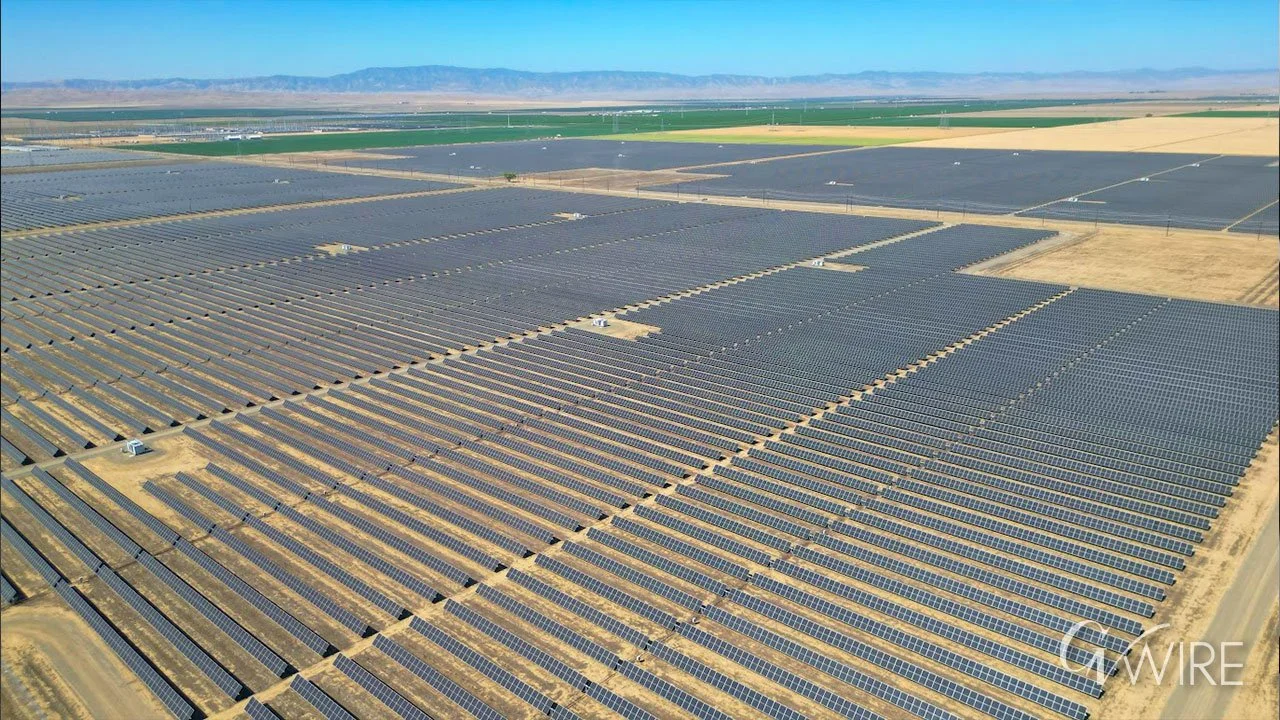
Woolf Farming was an early adopter of leasing farmland for solar facilities in western Fresno County. (GV Wire/Jahz Tello)
By Nancy Price
July 1, 2024
A wide band of sun-baked land running along the Interstate 5 corridor in western Fresno County is the proposed site for a large-scale solar farming, electricity storage, and transmission project that could produce as much as 20,000 megawatts of solar-generated electricity — enough for nine million homes.
“We need to learn how to say yes to these projects.” — Shannon Eddy, executive director, Large-scale Solar Association
Proponents say the Valley Clean Infrastructure Plan would provide the infrastructure, including five new substations and high-voltage lines that would be needed to move that much power onto California’s electrical grid, in addition to the master-planning of up to 130,000 acres owned by Westlands Water District or held privately by farmers.
That’s nearly double the size of the city of Fresno’s footprint.
It would dwarf the solar generation facilities now operating in the region. One of the largest is Westlands Solar Park in Kings County, right next to the Fresno County line and just southwest of Lemoore. It covers 20,000 acres and produces about 1,170 megawatts with a capacity of 2,700 megawatts. By contrast, Fresno County’s largest solar farms straddle Highway 33 northwest of Cantua Creek and combine for nearly 3,000 acres and more than 400 megawatts, according to the U.S. Solar Photovoltaic Database.
Ground Zero for California Solar
The westside of the Central Valley has been identified as a key location for solar energy generation plants, for several important reasons. It’s near the center of the state and existing transmission lines. Farmers and growers are facing a water crisis brought on by restrictions on groundwater pumping combined with decreases in surface water allocations and are in need of new revenue streams. And the same sunshine that has made the Central Valley one of the world’s most productive farm belts can be harvested as electricity.
Solar farming gives new use to land that has been fallowed either because it is drainage impaired or because of a lack of water pumped from the ground or shipped from Northern California through the state’s aqueducts.
In addition to providing a new source of revenue for farmers, the massive amount of solar energy and storage that the VCIP project proposes would move California closer to meeting its mandated goal of carbon-free energy generation by 2045.
While VCIP’s potential output of 20,000 megawatts might be enough for nine million homes today, in the future Californians will need even more electricity to power their vehicles and their home HVACs and appliances like water heaters and stoves as the state goes all-electric.
Clearly, future Californians will need much more solar-generated electricity, and projects like VCIP will be “critical,” says Shannon Eddy, executive director of the Large-scale Solar Association, an advocacy organization for utility-scale solar developments that’s based in California. Eddy notes that she’s heard of only one other 20,000-megawatt project starting up, and it’s in China.
California’s zero-carbon future rides on getting projects like VCIP up and running, Eddy said.
“And not just this one, but really all the utility-scale solar projects are needed,” she said. ” … We need to learn how to say yes to these projects.”